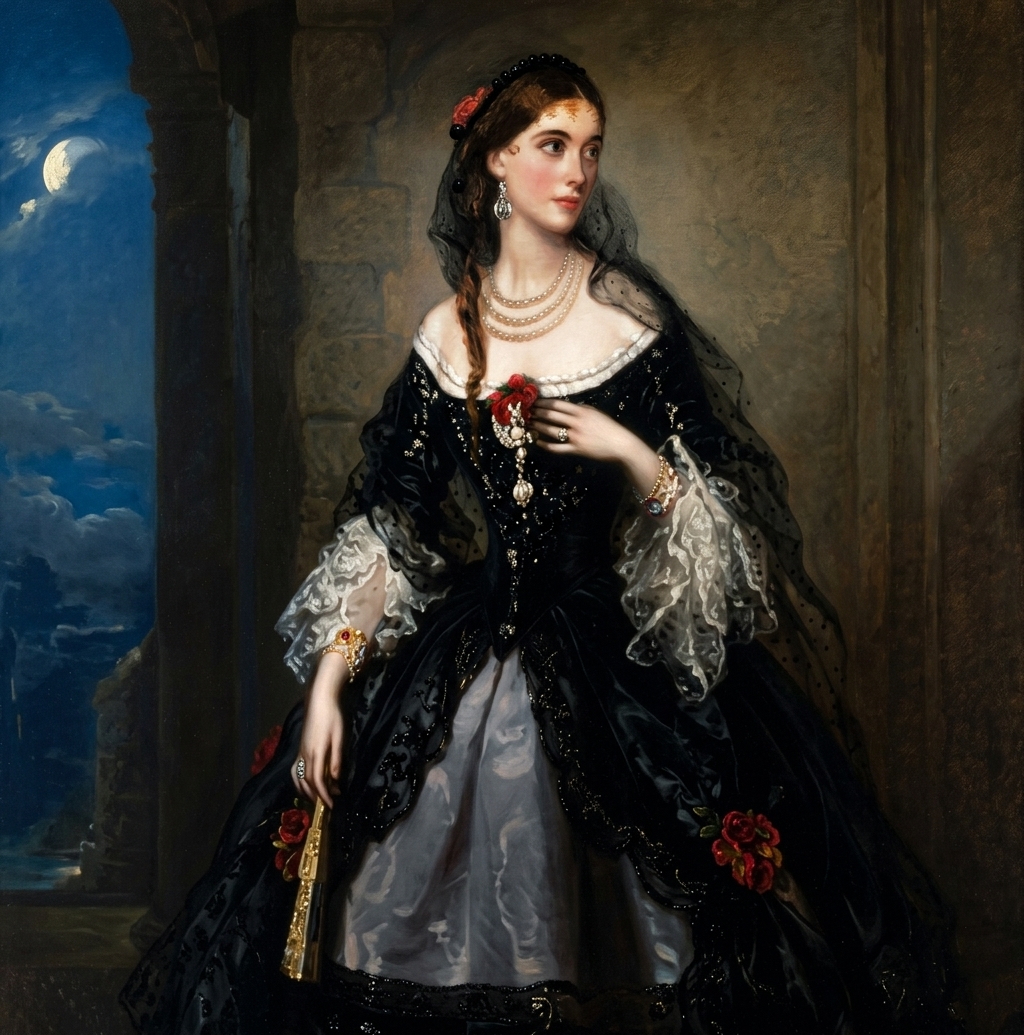
Adeline Louisa Maria de Horsey spent her life moving between two identities: the aristocratic woman trained to belong at court and the scandalous countess who eventually became part of Northamptonshire folklore. She was presented to Queen Victoria, courted by a claimant to the Spanish throne, married the celebrated commander of the Charge of the Light Brigade, and later became famous for smoking in public, wearing military trousers, entertaining near the dead, and reportedly testing out her own coffin.
The most dramatic stories about Adeline often came from Adeline herself. This timeline details Adeline’s life.
Adeline Louisa Maria Kilderbee was born near Berkeley Square in London, the eldest child and only daughter of Spencer Horsey Kilderbee and Lady Louisa Maria Judith Rous. Her father adopted the surname de Horsey in 1832, after which she became known as Adeline de Horsey.
Raised among Britain’s social elite, Adeline learned music, dancing, riding, and the polished manners expected of an aristocratic young woman. In her memoir, she also remembered attending a children’s party with the young Princess Victoria before Victoria became queen.
At seventeen, Adeline was formally presented at court by her mother. Soon afterward, she attended Queen Victoria’s first fancy-dress ball at Buckingham Palace dressed as a shepherdess from the reign of Louis XV.
This was Adeline’s official entrance into fashionable society, the world she had been trained to enter and would later scandalize.
Lady Louisa de Horsey died of scarlet fever when Adeline was eighteen. Adeline later described it as the first true sorrow of her life. With her brothers frequently away, she took over the management of her father’s household.
Her mother’s death matters to the story because Adeline repeatedly presented her as the model of feminine warmth and social grace that she spent much of her own life trying to recover.
According to My Recollections, Adeline visited a fortune-teller in Westminster during the period of mourning after her mother’s death. Disguised in a borrowed cloak, bonnet, and heavy veil, she was told that she would wait years to marry, wed a high-ranking widower, gain and lose a great deal, marry again after his death, and live a long life. Adeline framed the prediction as an eerie summary of her life.
In 1848, Adeline met Infante Carlos, Count of Montemolín, the Carlist claimant to the Spanish throne. Their courtship involved secret letters, private meetings, and plans for marriage. Surviving letters reproduced in her memoir show that the relationship continued into 1849.
The romance became entangled with the Carlist cause. Adeline claimed that she lost respect for Carlos when he abandoned his political obligations and returned to London. Under pressure from the attention surrounding the match, and by her account, from Carlist agents who blamed her for distracting him, she ended the engagement in June 1849.
During a visit to Deene Park, Adeline attracted the attention of James Brudenell, 7th Earl of Cardigan. He was a wealthy aristocrat, a celebrated cavalry officer, and the commander associated with the Charge of the Light Brigade. He was also still married.
Their increasingly public rides and appearances together fueled gossip. When Adeline’s father demanded that she end the relationship, she left home and established herself in Norfolk Street near Park Lane. She then lived openly as Cardigan’s mistress.
Cardigan’s estranged wife, Elizabeth, died in London. Adeline’s memoir attempts to soften the scandal surrounding what happened next, attacking Elizabeth’s character. Stating that she was violent and an adulterer. Adeline insisted that she initially refused an immediate wedding out of respect for the dead.
Less than three months after Elizabeth’s death, Adeline married Cardigan at the Military Chapel in Gibraltar. She wore white silk with a blue scarf, and the couple celebrated with a ball aboard his yacht, the Airedale.
Marriage gave Adeline the title she had pursued, but it did not guarantee acceptance. Queen Victoria refused to receive her at court, and respectable society never entirely forgot how the relationship began.
After falling from his horse and remaining unconscious for three days, Lord Cardigan died at Deene Park on March 28, 1868. His body lay in state in the ballroom for twelve days. Adeline claimed that approximately 6,000 people came to view him before his burial at St. Peter’s Church, Deene, on April 9.
Cardigan left Adeline a life interest in his estates. She remained closely attached to Deene and to the public memory of her husband, preserving his military relics and overseeing work connected with his monument and the church.
The restoration of Deene Church and Cardigan’s elaborate tomb was completed after his death. The monument included an effigy of the earl with an effigy of Adeline beside him, an unusual choice for a widow who was still very much alive.
The image is an early sign of the overlap between grief, and eccentricity that later became central to Adeline’s legend.
While staying in Paris, Adeline met the Portuguese nobleman Dom António Manuel de Saldanha e Lancastre. He reportedly noticed her during her rides in the Bois de Boulogne and proposed through his relatives.
Adeline accepted, despite objections from some of her English friends.
Adeline and Dom António married at the Roman Catholic Chapel in King Street, Portman Square. She then combined her former and new styles and called herself the Countess of Cardigan and Lancastre, even though joining the two titles was not technically proper under the conventions of the British peerage.
The title reportedly irritated Queen Victoria for another reason: the queen sometimes traveled privately under the name “Countess of Lancaster.” Adeline had once again managed to collide with royal expectations simply by insisting upon her own identity.
The couple divided their time between England and continental Europe, but Dom António disliked country life and suffered from chronic bronchitis. In 1879, Adeline returned to England to manage estates that she believed were suffering in her absence. Her husband remained primarily in Paris, although she continued to visit him.
Their physical separation did not necessarily mean the marriage had collapsed. In her memoir, Adeline remembered him as a kind and devoted husband.
Dom António died suddenly of bronchitis in Paris and was buried at Père Lachaise Cemetery. Adeline later wrote that, during a séance, she received a message said to be from him: “Chère amie, je t’aime toujours”—“Dear friend, I still love you.”
As Adeline grew older, the social rules that once controlled her seemed to matter less and less. Later accounts describe her smoking cigarettes in public, cycling in Cardigan’s regimental trousers, and appearing in thick makeup and startling combinations of clothing.
Her relationship with death also became part of her legend. She reportedly organized steeplechases through a local graveyard and kept a specially made coffin in the house. The most repeated version of the story claims that she would lie inside it and ask her butler whether she looked elegant.
These stories made her a local curiosity, but they also served another purpose: Adeline learned how to turn exclusion into performance. If society intended to treat her as a spectacle, she would control the spectacle herself.
At eighty-four, Adeline published My Recollections, a collection of royal memories, romantic adventures, society gossip, personal defenses, and carefully arranged grievances.
It was presented as Adeline’s memoir but was ghostwritten with Maude Ffoulkes. That does not make it useless; it makes it a source that must be read with care. Adeline was not simply recording her life. She was trying to regain control of a reputation that had already hardened into folklore.
Adeline died at Deene Park at the age of ninety. She was buried on May 28 at St. Peter’s Church, near Lord Cardigan and the monument that already carried her likeness.
It was an appropriately complicated ending. She died in the house tied to the title that had brought her both status and rejection, and she was laid to rest beside the husband whose memory had shaped the rest of her life.
The life behind the legend
Adeline’s life does not fit neatly into either tragedy or triumph. She was privileged, reckless, wounded, theatrical, and often her own most determined mythmaker. Some of the rejection she faced came from rigid Victorian standards; some of it followed choices she knowingly made; and some of the strangest stories about her were stories she helped preserve.
By the time she wrote her memoir, Adeline had already become the Countess of Cardigan. Later generations would remember her as the society beauty who defied her family, married a war hero, lost her place at court, entertained among the dead, and tried one final time to write her own ending.
Leave a Reply